

He was 53 years of age, for the time an old man, certainly older than most of the men who stood at Lexington Green that April morning 250 years ago. A woodworker and small farmer, he came from a family with deep ties to the town. He was a weathered man, sometimes a stubborn man, a man who liked a drink, loved the ideal of liberty, He was someone we would know today as quintessentially American.
His name was Jonas Parker, and he was one of the first men to die for the idea of America, on the grass of Lexington Green just over 250 years ago.
As the battle on Lexington Green began, Parker was joined by a number of his relatives and neighbors, facing off against the most formidable fighting force in the world at that time. It was an uneven match in manpower, experience, and capability, but it was only the first battle of the war, not the last. The British fired, and Parker and seven other Americas were struck. The militia returned fire.
As he fell to his knees, mortally wounded, Parker fired again and reloaded, pulling the lead balls from his hat, which he’d placed on the ground between his feet before the battle was joined. While reloading, he was bayonetted. His, and the bodies of the other eight causalities, were looted by the British.
It was a rout, but not for long.
Jonas was one of many Parker’s on the Green that day. After he fell, his cousin Captain John Parker of the Lexington Militia, rallied his men and chased the British back from Concord to Boston under withering, deadly sniper and skirmishing fire, turning the British march into a chaotic retreat. The British were saved only by the arrival near Boston of reinforcements and field artillery. It became known as “Parker’s Revenge."
Lexington and Concord showed the Crown that Americans were no longer willing to live under its yoke.
While not the most famous name in the war, Jonas Parker’s death was the first of a solider in active resistance to British authority, the first blood of the Revolution spilled as an American fighting for independence. The British had killed Americans before, but not on the battlefield.
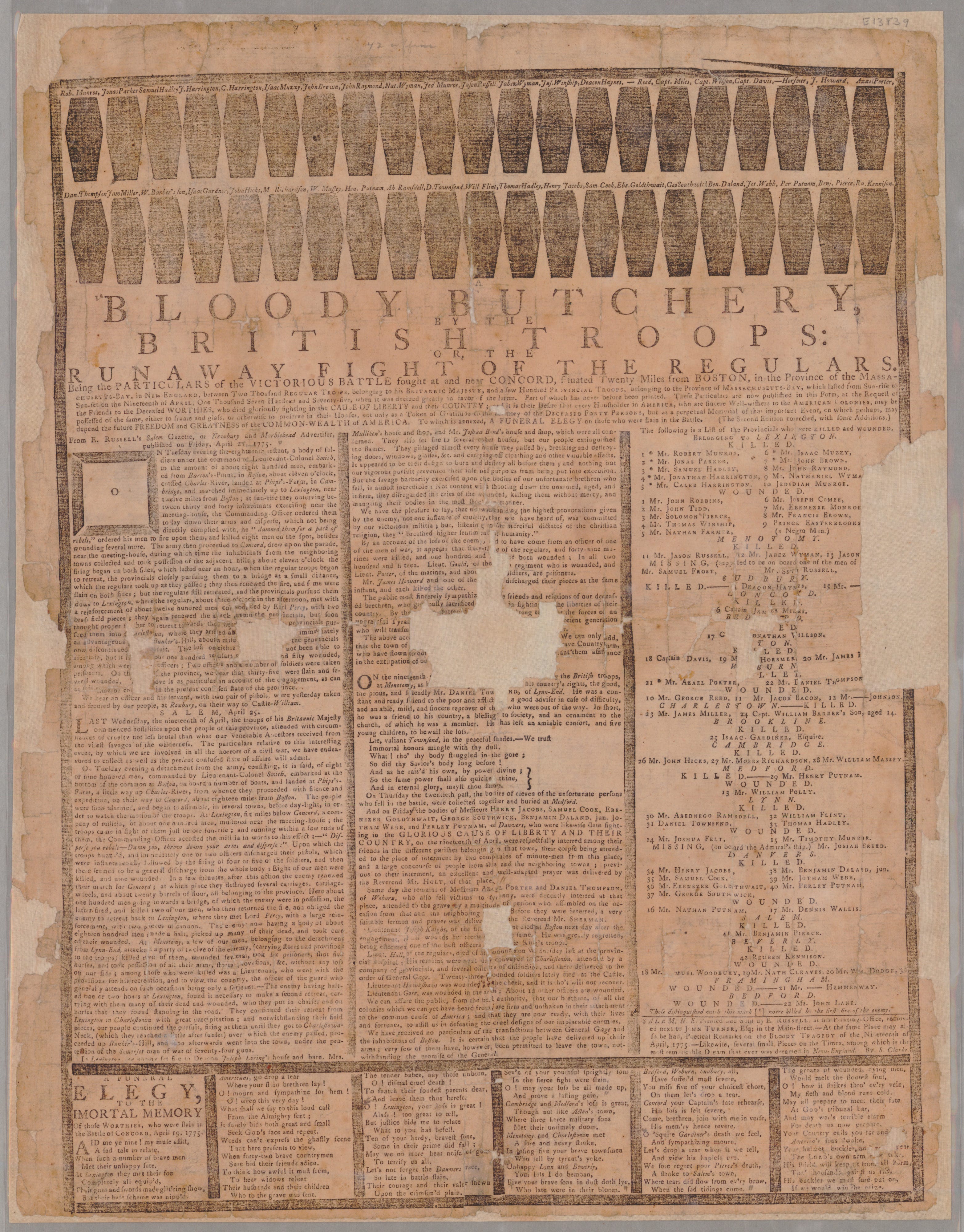
Massachusetts Governor Edward Everett spoke at Lexington in its 60th anniversary in 1835, a rich telling of Jonas Parker’s story:
“History, Roman history, does not furnish an example of bravery that outshines that of Jonas Parker. A truer heart did not bleed at Thermopylae. He was the next-door neighbor of Mr. Clarke, and had evidently imbibed a double portion of his lofty spirit. Parker was often heard to say that be the consequences what they might, and let others do what they pleased, he would never run from the enemy. He was as good as his word; — better. Having loaded his musket, he placed his hat, containing his ammunition, on the ground between his feet, in readiness for a second charge. At the second fire he was wounded and sunk upon his knees, and in this condition discharged his gun. While loading it again upon his knees, and striving in the agonies of death to redeem his pledge, he was transfixed by a bayonet, and thus died on the spot where he first stood and fell.”
Parker’s courage is not just a historical footnote—it is the foundation of a long, unbroken tradition of American sacrifice and courage. It is his lineage that runs through the long tale of duty and honor at the cost of his own life that extends to this very moment; the willingness to stand, to fight, to give all for the idea and the ideals of this nation.
From the blood-soaked fields of Gettysburg, to the beaches of Normandy, icy hills of Korea and the steaming jungles of Vietnam, to the deserts of Iraq and the mountains of Afghanistan, Americans have answered the call not because war is desirable or easy, or that glory is guaranteed, but because the cause of liberty demands defenders. They have done so in acrid deserts, steaming jungles, the fields and forests of Europe, on raging seas, in dusty cities, and high in the skies in fearsome machines.
Each fallen soldier, sailor, airman, or Marine stands in the lineage of Jonas Parker: ordinary men and women transformed into heroes by the clarity of a moment and the courage of conviction.
Too often, we sadly do not deserve such men and women who perish in our names.
They have died not for a leader or a party, but for an ideal of America, for our Constitution, for our nation, and for a cause larger than the petty ideologies of the moment.
On Memorial Day, we honor not only the known names carved into granite walls and white stone crosses, but also the quiet valor of men like Jonas Parker who are nearly forgotten by history.
His death, and the deaths of every solider since, reminds us that freedom is not abstract. It is earned, often painfully, by people who may never see the future they die to protect.
His legacy and that of over 1.3 million other men and women lost in service, endures in the silence of flags at half-staff, in the folded triangles handed to grieving families, and in the hearts of a nation that owes its very existence to the willingness of its citizens to stand and say, “I will not run. I will stand and die here.”
Good history lesson. And here we are with Commander-in-Chief Bone Spurs, who yammers about trophy wives at West Point and thinks dead soldiers were suckers. Meanwhile, the GOP gives lip service while defunding the VA.
I did not know of Jonas Parker. History is so full of unknown heroes. Thank you, Rick, for lifting up this inspiring story.