

In a moment where things are darker than we’ve seen, I woke up this morning and decided to deliberately, assertively imagine a hopeful future for America. I hope you enjoy this look at a single day in the White House in the year 2030.

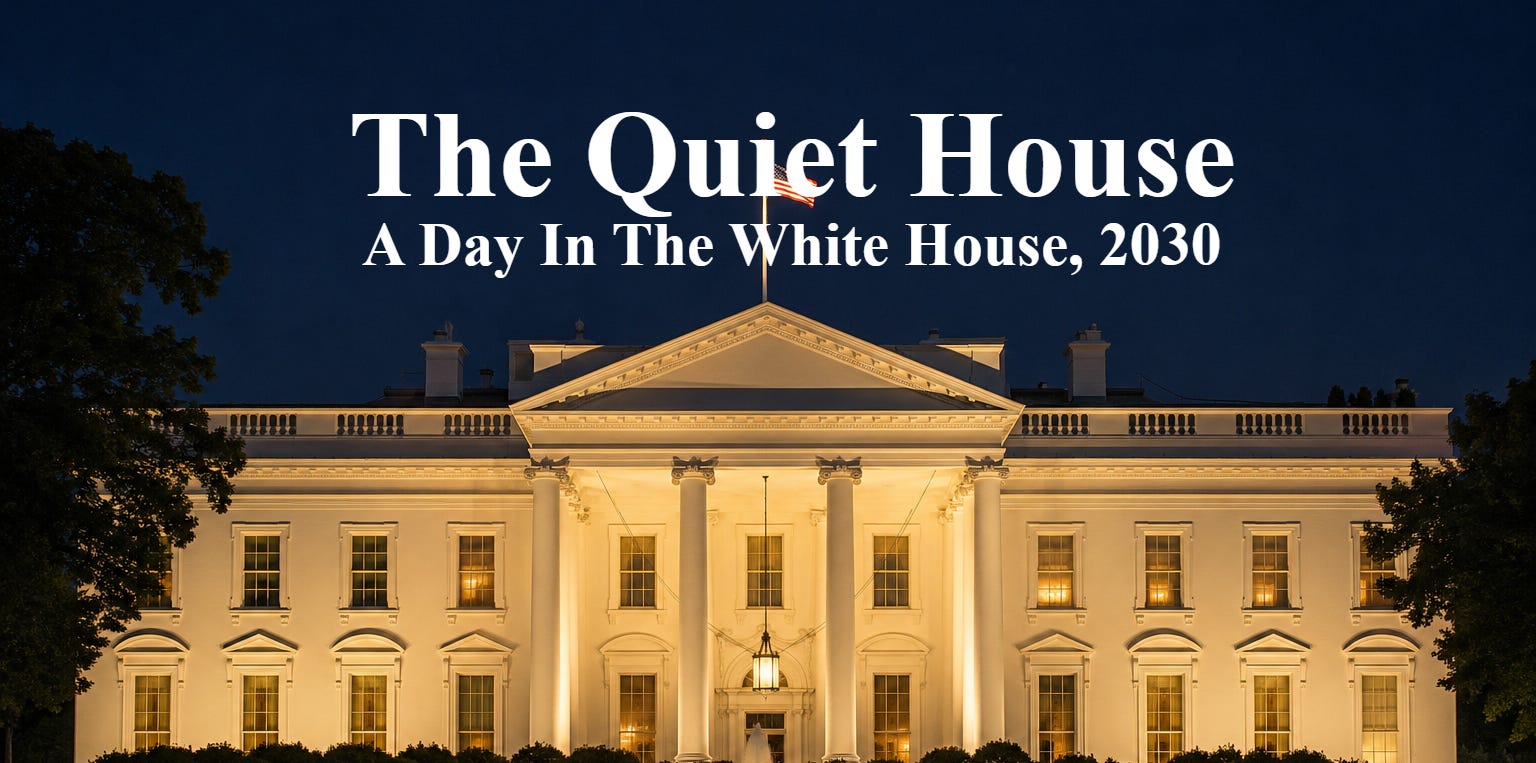
The first thing you notice, walking into the West Wing on a June day in 2030, is how quiet it is.
Not the quiet of paranoia and Dear Leader guerrilla warfare that defined the kill-or-be-killed ethos of the prior Administration’s intramural warfare.
It’s the quiet of competence. The quiet of people who know what they’re doing and don’t need to spend the day screeching about it on social media.
There are no aides using ChatGPT to concoct the perfect lib-owning tweet. No 24/7 Fox feed of cable talking heads glibly lying from every screen. The day’s agenda wasn’t set by a 2 a.m. social media tantrum that detonates the day before the Usher’s office brings in the excellent coffee.
Oh, they’re hustling, but not in the chaotic frenzy of the past. It’s just the low hum of a Presidency that has remembered, after a long and humiliating fever, what it’s there to do and how to do it.
The President is already at his desk.
He’s a former governor, a Democrat from a red state with real weather and real winters, the kind of place where you learn that a pothole doesn’t give a damn whether you’re a Republican or a Democrat. He ran on a heresy that turned out to be common sense: that the country was sick of the whole goddamn drama of the previous era.
Sick of the grunting nationalism that mistook cruelty for strength. Sick of the algorithm-poisoned rage that passed for political thought. Sick of dumb culture wars and dumber comebacks. Sick of an economy designed to extract wealth from families, farms, and working folks and funnel it to private equity and AI overlords stacking the deck.
And he said the part his own side didn’t want to hear, too.
He told the snobs and the scolds and the seminar-room revolutionaries that the lecturing was over, that you don’t save a country by hating half of it. His own party hated that he wouldn’t shape himself to their beloved policy fantasies from the 1990s and early 2000s, but his departure from them won him the 2028 election.
He isn’t a faux-Solomonic centrist splitting every difference down the middle.
He is something rarer. He believes. Despite it all, he believes in America, in the old foundation and the new dreams. He likes facts, science, and laws. He likes people. His tolerance for bullshit and posturing is near zero. He knows where the country needs to go, and has the nerve to walk it there.
His first meeting is the President’s Daily Brief.
His intelligence briefer walks him through the chaos in Russia following Putin’s assassination last year, China’s growing threats to Taiwan, and a new Iranian intelligence source. The President asks smart questions the briefer will have to return to tomorrow.
The Attorney General catches him for ninety seconds outside the Roosevelt Room. She’s not there for a photo op; she’s there to discuss a single national security matter, brought to her by the newly reconstituted National Security Division, regarding Russian payoffs to an official from the prior Administration.
What she doesn’t discuss, and he doesn’t inquire about, is the ongoing process of the Reform and Accountability Agenda.
He told her, and the American people, he would never interfere as the DOJ pursued cases covering the sweeping Epstein coverup in the last Administration. He promised the DOJ free rein to address the self-dealing, the contracts handed out to the former President’s family members, the crony deals to donors, the pardons sold like lottery tickets.
He kept that promise, and the machinery of accountability grinds on, methodical and unglamorous, case by case. Two of the former President’s sons are already under indictment. Three of his cabinet members are under investigation by the SEC. What’s left of the MAGA media screams about it, but the AG is tireless, meticulous, and lets the legal filings do the talking.
None of it is done for spectacle, though the MAGA dead-enders desperately want it to be. All of it is pursued under the rule of law. There’s no vengeance in her voice when she briefs Congress or the media.
There’s something better, something more frightening than the revenge fantasies of the last President. There are meticulous investigations, indictments, paperwork, process, rules, accountability. The most beautiful sound a republic can make is the dry rustle of the rule of law and due process doing their job.
The former FBI director, his deputy, the former Attorney General, and the former Acting Attorney General will be indicted in a week on sweeping conspiracy charges, but she’s keeping that close to her vest. Closer still: both the former FBI Deputy Director and the former White House Chief of Staff have turned state’s evidence and are ratting out the rest.
Then the kids arrive in the Oval Office.
Forty of them, fourth and fifth graders, bused and flown in from places like Hattiesburg and Bismarck and a reservation school in Arizona, scrubbed and nervous in their good clothes. They’re here for a reason that would have sounded like science fiction a decade ago. They’re going to help the President welcome the astronauts home, four of them back a week now from the lunar surface, smiling broadly.
One of the kids, a girl with a gap in her teeth and a NASA patch her grandmother sewed onto her jacket, asks the commander whether the Moon smells like anything. The commander crouches down to her level and tells her the truth the moonwalkers all came home with: like spent gunpowder, like fireworks. The girl goes still for a second, then grins so wide the gap shows.
“Were you scared?” she asks.
The commander whispers, “Nope. We had a great team here and a great team up there. We all worked together.”
The kids are too overawed, too wild with excitement, to notice that the Oval Office decor has been returned to a simpler, more traditional style. The wallpaper is a quiet pattern, and there is no sign of gold leaf or tacky ornamentation. None of them process that the two former Presidents’ portraits in the Oval are Franklin Delano Roosevelt and Abraham Lincoln.
The morning rolls on, undramatic, which is the highest compliment you can pay a government.
A delegation of foresters and geneticists joins the President and First Lady on the site of the demolished Ballroom to plant a stand of American chestnut trees, bred to survive the blight that killed nearly all of them. The great vanished giant of the eastern woods, four billion of them wiped out in a single generation, now clawing its way back from a few resistant survivors and a lot of patient, unfashionable science.
A reporter in the pool shouts, “Mr. President, is it symbolic that you’re planting trees where the ballroom stood?” He quips, “What ballroom?” and sets his shovel to work.
He joins the new USAID director in the Brady Press Room after that and answers questions about the restored agency. Not so long ago the whole apparatus had been torched to the studs by DOGE in a fit of performative cruelty, its lifesaving work mocked as waste by people who’d never watched a child die of something a two-cent packet of hydration salts could have prevented.
Now it’s back.
Rebuilt, leaner, unsentimental about results and ferocious about the mission. The director runs through it without drama: food aid in famine zone, disease monitoring, global vaccine distribution, clinics reopening in places the world had written off. American soft power doing the thing it does best: mercy, delivered with modern logistics.
Those bags of soybeans and seed corn and flour have “A Gift from The People Of The United States” on them again.
He spends a little call time poking the Senate Majority Leader and the House Speaker to pass a banking and financial reform bill, one that bans Congressional stock trading, regulates private equity, and carries anti-monopoly provisions Silicon Valley and Wall Street both hate, but that Americans approve by an 87% margin. He can’t quite defeat the power of lobbying and big donors yet, but he’s riding at a 74% approval rating, and Congress pays attention to that.
There’s a working lunch with seven fusion executives, and here’s a sentence nobody could have written with a straight face in 2024: the argument in the room isn’t whether fusion works. They made it work. The argument is about deployment, permitting, and grid connections, and how fast you can stamp these things out and flip the switch.
The President listens more than he talks, which is its own small miracle in that building. He wants a national plan by the end of the week. Not a subsidy free-for-all, not a decade of blue-ribbon commissions, but a six-month runway. Cheap, clean, near-limitless power, and a government finally acting like the future is something you build instead of something you fear. The economic impact of standing up the plants and the grid is enormous, and he’s determined to see it land on the American people.
He drops in on a meeting in the Old Executive Office Building, where his Vice President is, to put it mildly, stomping the guts out of a table of tech CEOs. He reminds them the AI Safety and Human Cognitive Liberty executive order will be rigidly enforced, and that the Vice President has his absolute support.
It’s been the toughest thing they’ve taken on, but they’re making progress. She winks at him as he leaves, knowing he was the good cop in that little show.
The tech bros think they’re being unfairly singled out, but the President is about to announce the Media Monopolization Divestiture Executive Order next week, and the VP is looking forward to putting the executives from Paramount, Fox, and Sinclair in the same seats the tech bros are squirming in now.
And below the President, the White House and Cabinet are working. They know the scope of what they face, and know that nothing can be trolled or tweeted away. They win some battles. They lose others.
The machine they defeated is far from dormant. But the President’s bond with working-class Americans and farmers, and his obvious dedication to them, is a change no one has figured out how to overcome. Too many in both parties still think “Giving a damn” isn’t a policThe former President’s party is now deeply associated in the minds of voters as the party of billionaire tech CEOs, corruption, violence, and the long cover-up of Jeffrey Epstein.
Through it all, the East Wing is a construction site.
You can hear it faintly, the saws and the hammers, the patient percussion of a loving restoration. They’re rebuilding what was torn down, and they’re doing it right: plaster and hand-cut molding and craftsmen who know how to match a cornice two hundred years old. It would be faster to throw up drywall.
They’re not doing that. The First Lady, an architect by training, made the call that the house should be repaired the way you repair a thing you intend to keep. It’s a promise being kept, one careful joint at a time. The young men and women doing the work know this is a job they’ll tell their kids about.
The day’s real headline arrives in the evening, in black tie.
Ukraine’s President comes up the drive in the long gold light of a Washington afternoon, and the state dinner that follows isn’t a victory lap, exactly, because the cost was too high for that word.
But it’s something better. A free country, still standing, its President walking into the people’s house as an honored guest and an equal, toasted by an America that decided, after a dangerous detour that scared the hell out of the world, to remember which side of history it actually wanted to be on.
The toasts are warm. The wine is from a rising Sonoma vineyard owned by a young man who immigrated to America as a child. Somewhere out past the gates, the cynics are sure it’s all theater.
And then, late, the guests gone, the caterers wheeling their carts back into the night, the President does something presidents almost never get to do.
He stops.
He goes out alone onto the Truman Balcony with his jacket off, and he stands there in the dark, holding the First Lady’s hand.
They look out a long time over the South Lawn at the Washington Monument, lit white against a black sky, the same obelisk that watched over this place through good eras and bad, that survived worse than us and better than us.
No cameras, no staff, no tweets.
Just a tired man, standing in the quiet he fought to restore, looking at a monument to George Washington, a man who could have been a king and chose, instead, to go home.
The country isn’t fixed. Countries never are. The only easy day was yesterday. There’s a long list waiting on his desk for tomorrow, and the morning will bring its own ten thousand problems, because that’s the deal, that’s the only deal there’s ever been for the men who sit behind the Resolute Desk.
But the lights are on again. The work is honest. The kids met their astronauts. The chestnut tree is coming back. Across the world, some child isn’t going to die of dysentery or starvation.
And for one quiet minute on a summer night in 2030, the most powerful person on earth gets to stand on his own balcony, breathe the cool air off the lawn, and feel something this country had nearly forgotten it was allowed to feel.
Hope. Hard-earned and tenuous, but hope nonetheless.
We all need to manifest this. Thank you.
Didn’t expect to get choked up reading a goddamn Substack this morning, Richard.